Guide

Can You Charge a Late Fee on an Invoice? (With Wording)

By i-quote team8 min read

Short answer

Usually yes: you can charge a late fee on an invoice if the client agreed to it in writing before the work started and the amount is within the limits where you and your client are based. Put it in your quote or contract, repeat it on the invoice, and add it only after the due date and any grace period.
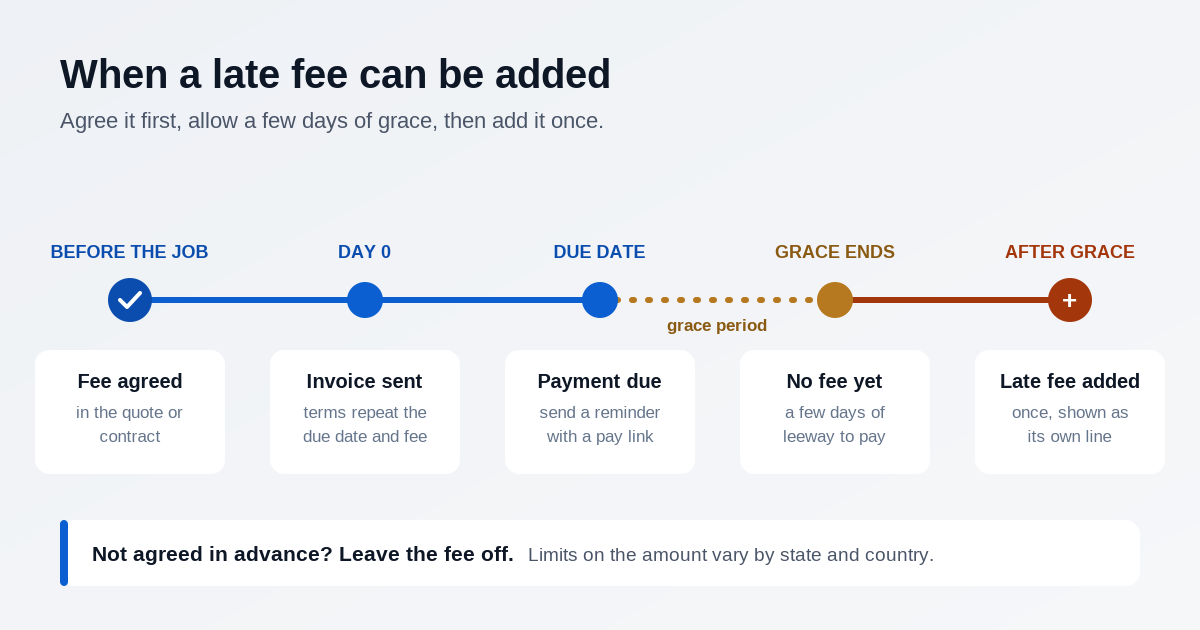
Timeline of a late fee: the fee is agreed in the quote or contract before the job, the invoice is sent with terms that repeat the due date and fee, payment is due, a grace period of a few days passes with no fee, and only then is the late fee added once as its own line.

A client is two weeks late, you have sent the reminders, and you are wondering whether you can add something to the bill for the wait. A late fee can be fair, and the prospect of one gets some invoices paid sooner. But it only works if it was set up before the invoice went out.

Below: when you can charge a late fee, the common ways to set one, how to calculate it, and wording you can copy for your quote, your invoice and the email that tells a client a fee has been added. This is general information, not legal advice.
Can you charge a late fee on an invoice?

A late fee is a term of your agreement with the client, like the price and the due date. If the client agreed to it in advance, in a quote they accepted, a contract they signed or terms they were given before the job, you can usually charge it. Adding a fee the client has never seen to an invoice that is already overdue is hard to enforce and a good way to lose the client.

How much you may charge, and whether extra rules apply when your client is a consumer rather than a business, depends on where you and your client are based. Some places also give businesses a right to interest on late payments by law. In the UK, for example, that is the Late Payment of Commercial Debts (Interest) Act 1998, explained on gov.uk. Check your own state or country's rules before you set a fee.

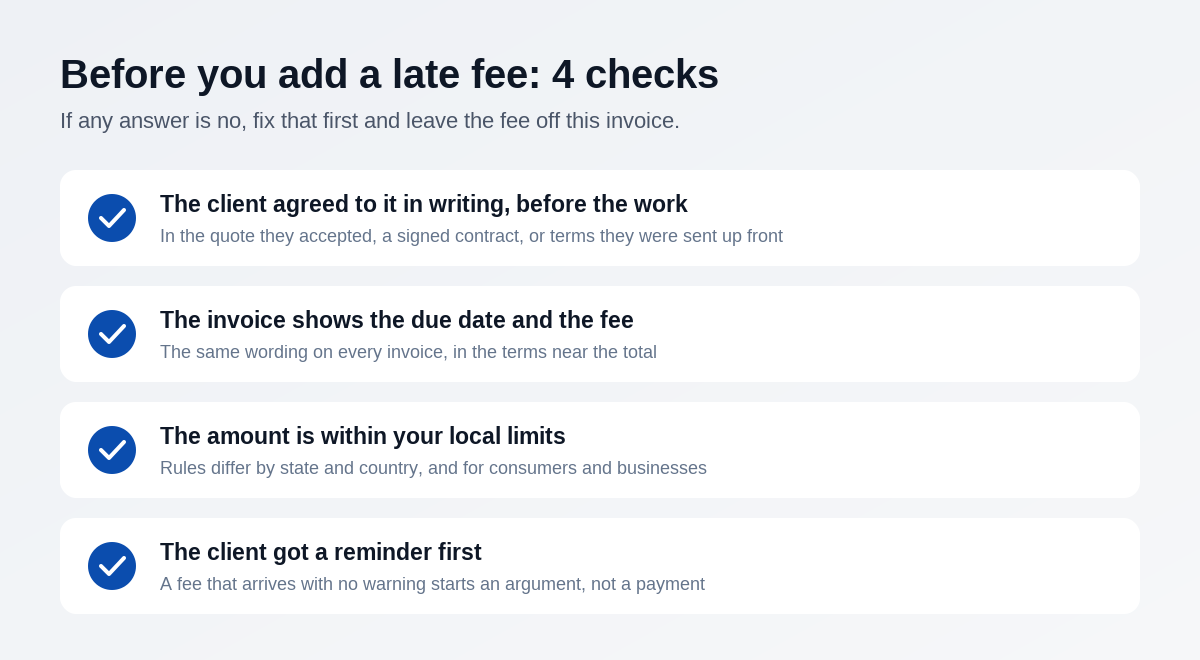
Checklist of four checks before adding a late fee to an invoice: the client agreed to it in writing before the work, the invoice shows the due date and the fee, the amount is within your local limits, and the client got a reminder first.
Four checks. If any answer is no, leave the fee off this invoice and fix your terms for the next one.

What is the standard late fee on an invoice?

There is no single standard. Late fees on invoices take three common forms, and which one suits you depends on the size of your invoices and how long clients tend to run late.

  • Flat fee: one fixed amount, added once. Easy to explain, but the same fee lands on a small invoice and a large one.
  • One-time percentage: a percentage of the unpaid balance, added once. It scales with the invoice and stays simple.
  • Monthly percentage: a percentage of the unpaid balance for each month the invoice stays unpaid. Sometimes written as an annual interest rate instead.
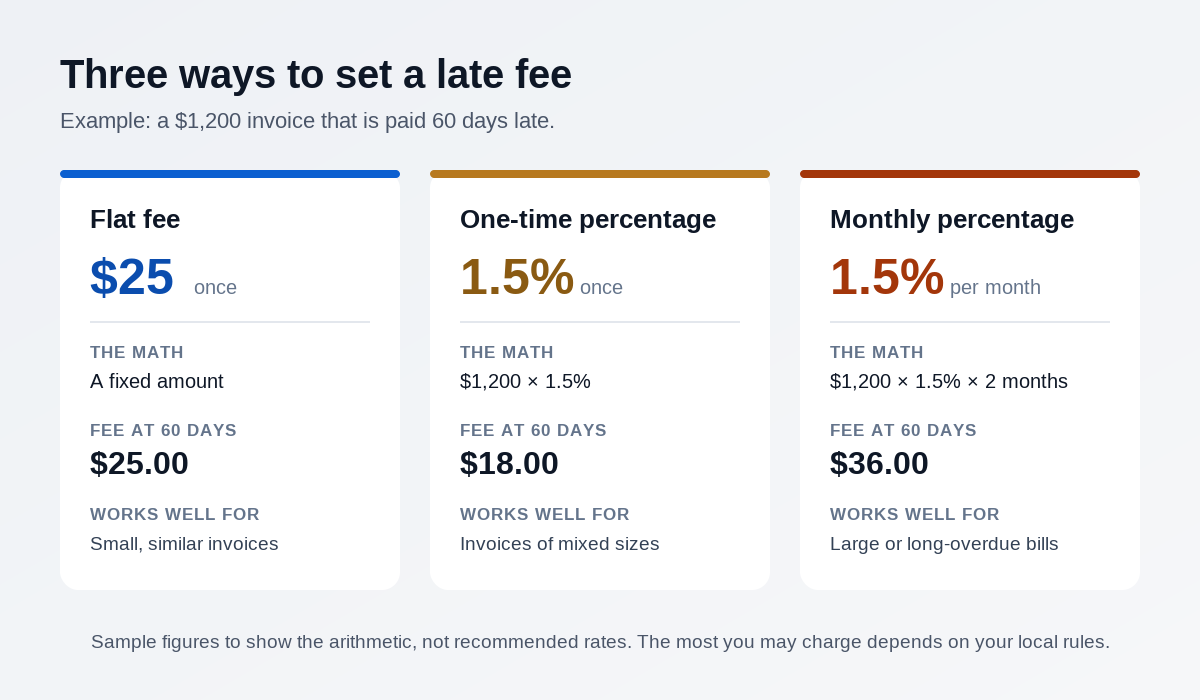
Three ways to set a late fee, using a $1,200 invoice paid 60 days late: a flat fee of $25 comes to $25.00, a one-time 1.5 percent fee comes to $18.00, and 1.5 percent per month for two months comes to $36.00. The figures are samples, not recommended rates.
The same late invoice under three kinds of fee. The numbers show the arithmetic; they are not recommended rates.

How to calculate a late fee on an invoice

Work from the unpaid balance. If the client has paid part of the invoice, the fee applies to what is still owed, not to the original total.

  • Flat fee: the fixed amount in your terms, once.
  • One-time percentage: unpaid balance × rate. Example: $1,200 × 1.5% = $18.00, so the client now owes $1,218.00.
  • Monthly percentage: unpaid balance × monthly rate × months late. Example: $1,200 × 1.5% × 2 months = $36.00.
  • Annual rate charged by the day: unpaid balance × annual rate ÷ 365 × days late. Example: $1,200 × 12% ÷ 365 × 30 days = $11.84.

How to word a late fee on an invoice

Keep it to one or two plain sentences in the terms of the invoice: when payment is due, when the fee starts, and how much it is. Use the same wording on every invoice, and make sure it matches what the client agreed to in your quote or contract.

Invoice terms · late fee wording

Flat fee: Payment is due within [14] days of the invoice date. Invoices still unpaid [7] days after the due date are subject to a late fee of [amount]. One-time percentage: Payment is due by [due date]. A one-time late fee of [X]% of the unpaid balance is added to invoices not paid within [7] days of the due date. Monthly percentage: Payment is due within [30] days of the invoice date. Overdue balances are charged [X]% per month, or the highest rate the law allows if that is lower.

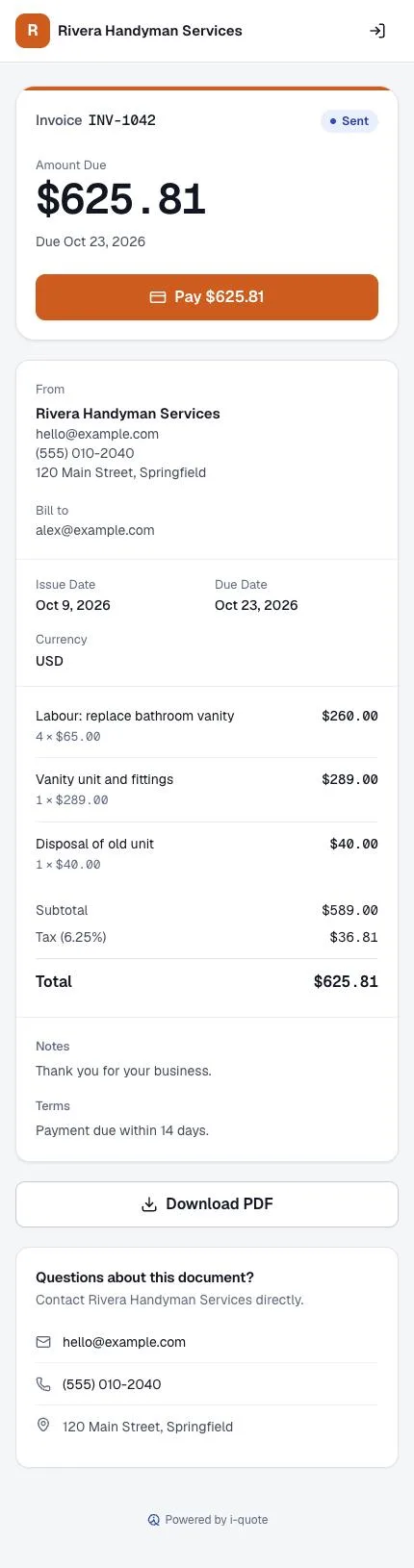
An i-quote invoice on a phone screen: Rivera Handyman Services, invoice INV-1042, $625.81 due Oct 23, 2026, a Pay $625.81 button, three line items, and under them a Terms section that reads "Payment due within 14 days."
Terms sit right under the line items on the invoice your client opens, so the due date and any late fee wording are in plain sight (sample data).

Late fee clause for a quote or contract

This is the step that makes the fee stick: the client sees it and says yes before any work starts. Put it with the price and the due date, not in small print at the end.

Quote or contract · payment terms

Payment terms: invoices are due within [14] days of the invoice date. If an invoice is not paid within [7] days of its due date, a late fee of [X]% of the unpaid balance (or [amount]) will be added. By accepting this quote you agree to these terms.

How to tell a client a late fee has been added

Remind first, charge second. A reminder on the due date and another a few days later give the client a fair chance to pay before any fee applies. When you do add it, say so in a short, factual message with the new balance and a way to pay.

Email · late fee added

Subject: Invoice #[number]: late fee added, new balance [new total] Hi [name], Invoice #[number] for [work] was due on [date] and is still unpaid. As set out in our payment terms, a late fee of [fee] has been added, so the balance is now [new total]. You can pay by card here: [payment link] If the payment is already on its way, or something on the invoice looks wrong, just reply and I will sort it out. Thanks, [your name]

Can you charge late fees on late fees?

Charging a new fee on top of an earlier unpaid fee is compounding. It makes the balance grow quickly, it is harder for a client to check, and the rules on it differ from place to place.

The simpler approach is to calculate every fee on the original unpaid balance only, or to charge one fee, once. A client who can see exactly how the number was reached is more likely to pay it without a dispute.

When should you waive a late fee?

A late fee is there to get you paid on time, not to earn extra. Waiving it is your choice, and it often buys more goodwill than the fee is worth. Say so in writing: "I have removed the late fee this time as a courtesy."

  • A good client is late for the first time
  • The invoice had a mistake, or went to the wrong person
  • You are still sorting out a question about the work itself
  • The client pays the rest in full as soon as you ask

Add the late fee automatically in i-quote

In i-quote you set a late fee percentage and a grace period in Settings. Once an invoice is overdue and the grace period has passed, the fee is added once. It never compounds, and it applies only to invoices created after you set it. Whether to charge a fee, and how much, stays your decision under your own terms and local rules.

Before that point, i-quote emails reminders in your business's name: by default 3 days before the due date, on the due date, and 1, 7 and 14 days after it. Each has a Pay button for card payment through Stripe, straight into your own Stripe account, at Stripe's standard fee only; i-quote adds no fee per invoice. Reminders stop as soon as the invoice is paid.

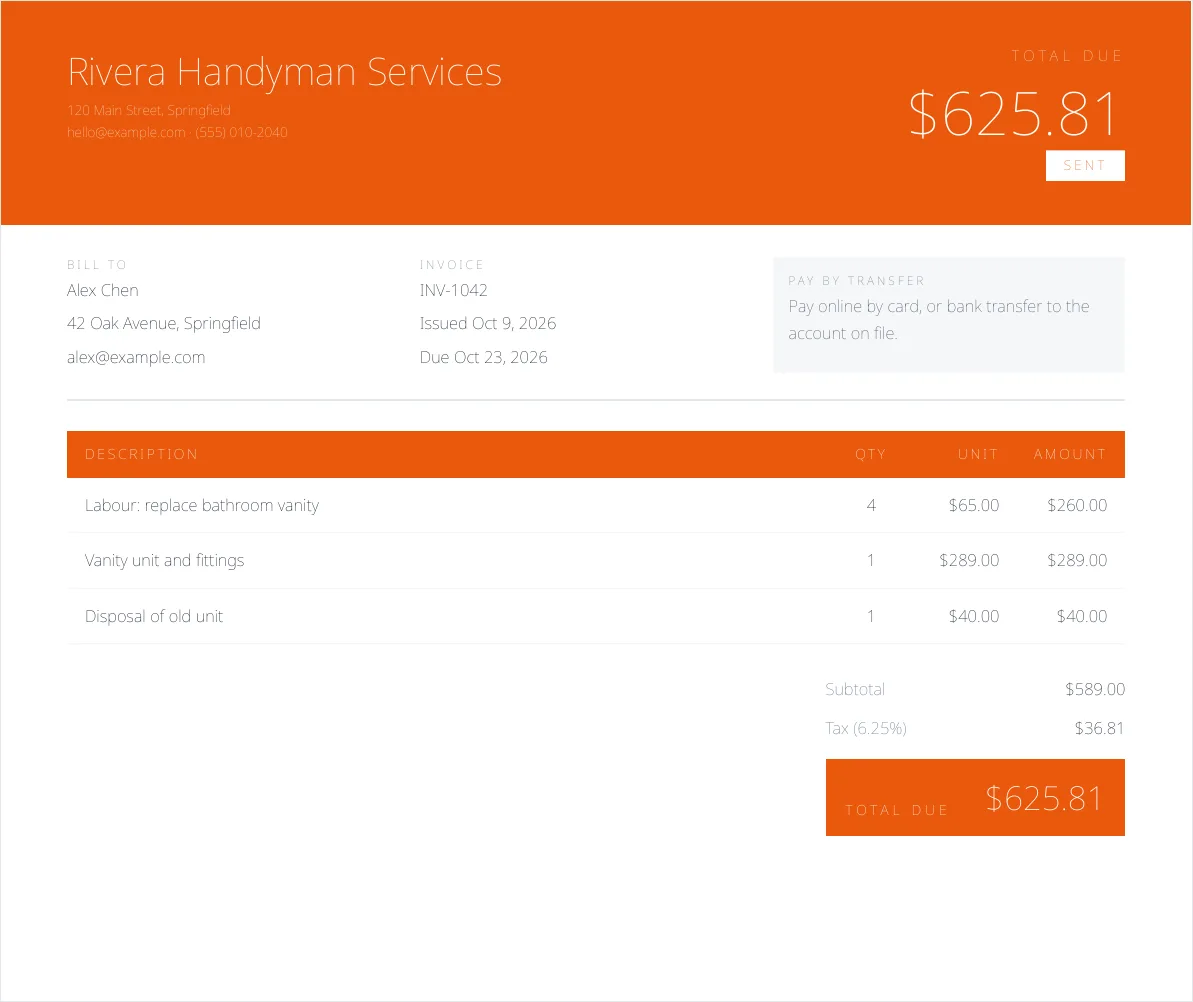
An i-quote invoice in the Trade template for Rivera Handyman Services: an orange header with total due $625.81 and a Sent badge, invoice INV-1042 issued Oct 9, 2026 and due Oct 23, 2026, three line items, subtotal $589.00 and 6.25 percent tax of $36.81.
An i-quote invoice with the due date next to the invoice number, where a client looks first (sample data).

Frequently asked questions

What is a reasonable late fee percentage on an invoice?
There is no one figure. It depends on the limits where you and your client are based and on the size of your invoices. Pick an amount you would be comfortable explaining to a client, and check your local rules before you put it in your terms.
Do I have to give a grace period before a late fee?
Rules differ by place, so check yours. Even where none is required, a few days of grace allows for weekends, bank transfer times and honest mistakes, and it makes the fee much easier to defend.
Can I add a late fee that was not in the quote or on the invoice?
It is best not to. A fee the client never agreed to is hard to enforce and likely to be disputed. Add the wording to your quotes and invoices now, and apply it to future jobs.
Is a late fee the same as interest?
Not quite. A late fee is usually a flat amount or a one-time percentage, while interest keeps growing for as long as the invoice is unpaid. Both need to be in your agreed terms, and local rules can treat them differently.
Is an early payment discount better than a late fee?
It can be. A line such as "2% off if paid within 10 days" rewards fast payers instead of penalising slow ones, but it costs you margin on every client who would have paid on time anyway. Some businesses use both.