Guide

Estimate vs Quote vs Invoice: What's the Difference?

By i-quote team7 min read

Short answer

An estimate is a rough price that can change. A quote is a fixed price for a defined job, valid until a stated date, that the client accepts or declines. An invoice is the bill for agreed work, sent when the work or a stage of it is done, or when a deposit is due, with a due date for payment.
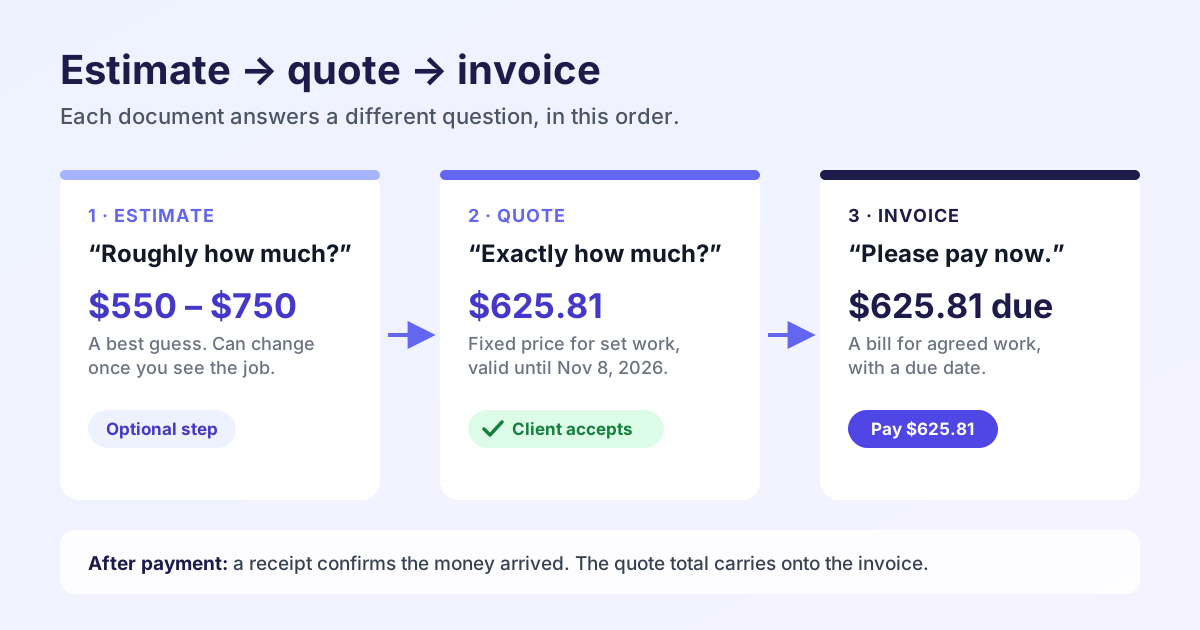
Three cards in order: an estimate asking roughly how much, with a $550 to $750 range that can change; a quote asking exactly how much, with a fixed $625.81 valid until Nov 8, 2026 and a client accepts tick; and an invoice saying please pay now, $625.81 due, with a Pay button. A receipt follows payment.

Estimate, quote and invoice get used as if they meant the same thing, and that is where many arguments about price start. A client who thought they had a fixed price gets a bigger bill, or a business that sent a rough number finds the client holding them to it.

Below: what each document is for, when to send which, how they differ from a bid, a proposal and a proforma invoice, and wording you can copy so the client always knows whether a price is fixed or approximate.
Is an estimate the same as a quote?

No. An estimate is your best guess at the cost before you know every detail, often given as a range ("$550 to $750"). It helps the client decide whether to go ahead, and the final price can move once you see the job.

A quote is a fixed price for a specific, written scope of work. It usually has a "valid until" date, because your material costs and your calendar change. If the client accepts it before that date, that is the price for that work. Anything outside the scope becomes a new quote or a written change, not a surprise on the bill.

Some trades and countries use the words differently, and how firmly an estimate or quote binds you depends on local rules. Whatever you call the document, say on it in plain words whether the price is fixed or approximate.

One line to put on every estimate

This is an estimate, not a fixed price. The final cost may change once we [inspect the site / confirm the scope]. We will send you a fixed quote to approve before any work starts.

Quote vs invoice: are they the same thing?

No. A quote comes before the work and asks "do you want this, at this price?". An invoice comes after the work, or a stage of it, and says "this is what you owe, please pay by this date".

The two often carry the same line items and the same total, because the invoice bills exactly what the client accepted. What changes is the question the document asks: a quote asks for a yes, an invoice asks for payment. That is why a quote has an Accept button and a "valid until" date, and an invoice has a Pay button and a due date.

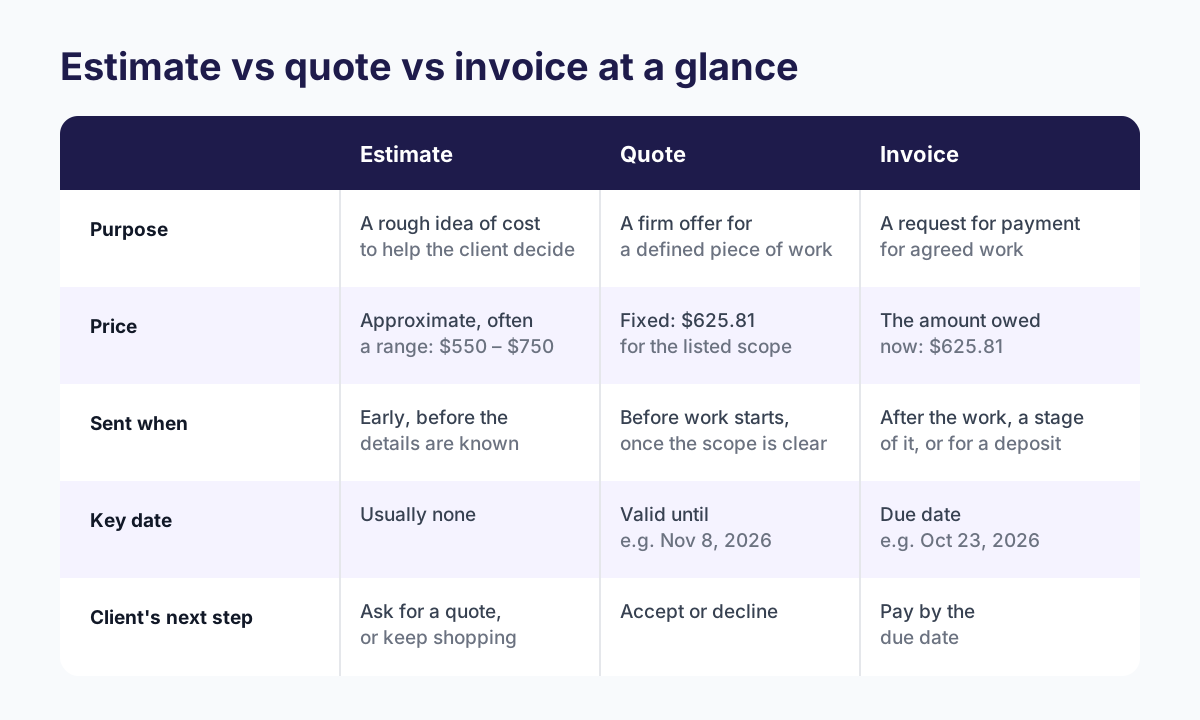
A comparison table of estimate, quote and invoice across five rows: purpose, price, when it is sent, the key date and the client's next step. An estimate is an approximate range with usually no date; a quote is a fixed $625.81 valid until a date that the client accepts or declines; an invoice is the amount owed with a due date that the client pays.
The same job, three documents: what each one is for and what the client does next.

Can a quote be used as an invoice?

Not as it stands. A quote does not ask for payment and has no due date, and your client's bookkeeping, and often your own records and tax filings, expect an invoice with its own invoice number and issue date. Send an invoice even when every line matches the accepted quote.

You do not have to retype it, though. Carry the line items and total over from the accepted quote, by copying them or by converting the quote in your invoicing tool, so the client sees exactly the numbers they agreed to, and add the quote number for reference.

Which one should you send, and when?

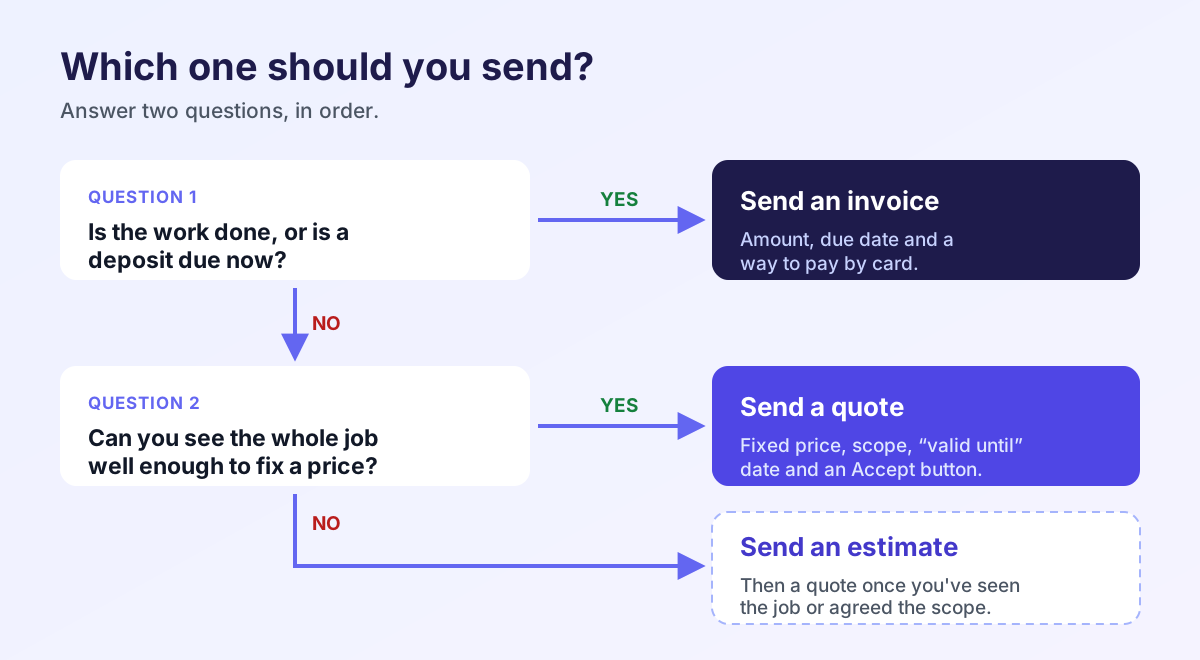
Ask two questions in order. Is the work finished, or is a deposit due now? Then it is an invoice. If not, can you see the whole job well enough to fix a price? Then send a quote. If you cannot, send an estimate and follow it with a quote once you have seen the job or agreed the scope.

For contractors and other trades, a site visit is often the step between the two: a phone estimate gets you through the door, the visit gives you what you need for a fixed quote.

A decision flow with two questions. Question 1: is the work done, or is a deposit due now? Yes leads to send an invoice. No leads to question 2: can you see the whole job well enough to fix a price? Yes leads to send a quote; no leads to send an estimate, then a quote once you have seen the job.
Two questions decide which document to send.

Estimate vs quote vs bid vs proposal

Whichever you send, the step after a yes is the same: an invoice for the agreed amount, or for a deposit first.

  • Estimate: an approximate price, often a range, that can change.
  • Quote: a fixed price for a defined scope, valid until a stated date.
  • Bid: a price submitted to win a job against other businesses, usually in answer to a request for bids, common in construction and public contracts. In practice it works like a quote.
  • Proposal: a longer document that explains how you would approach the work, with options, a timeline and the price. Agencies and consultants use it when the client is choosing an approach as well as a price.

Quote vs proforma invoice

A proforma invoice looks like an invoice but is sent before the work is done or the goods are shipped, to show the client exactly what the final invoice will say. Importers use it for customs and bank paperwork, and some businesses send one to request payment upfront.

A quote invites the client to accept a price; a proforma invoice confirms the details of a sale that is about to happen. Neither replaces the final invoice. Whether a proforma counts for tax or accounting purposes varies by country, so check with your accountant if you use them.

Quote vs invoice vs receipt vs purchase order

  1. Quote: you send it; the client accepts the price.
  2. Purchase order (PO): some business clients send you one after accepting, as their internal approval to spend. Put its number on your invoice.
  3. Invoice: you send it once the work or a stage is done, or a deposit is due; the client pays by the due date.
  4. Receipt: you send it after payment, confirming the money arrived.

From quote to paid invoice in i-quote

In i-quote you send a quote with your business's name, logo and colour and a "valid until" date. Your client opens it on any device and accepts or declines it online. Once it is accepted, one click turns it into an invoice with the same line items and total.

If the quote asks for a deposit, the invoice is issued as soon as the client accepts, and they pay at least the deposit by card from the invoice page. Card payments go through Stripe straight into your own Stripe account, at Stripe's standard fee only; i-quote adds no fee per invoice. Automatic reminders then follow up on anything still unpaid, and a receipt goes out when it is paid.

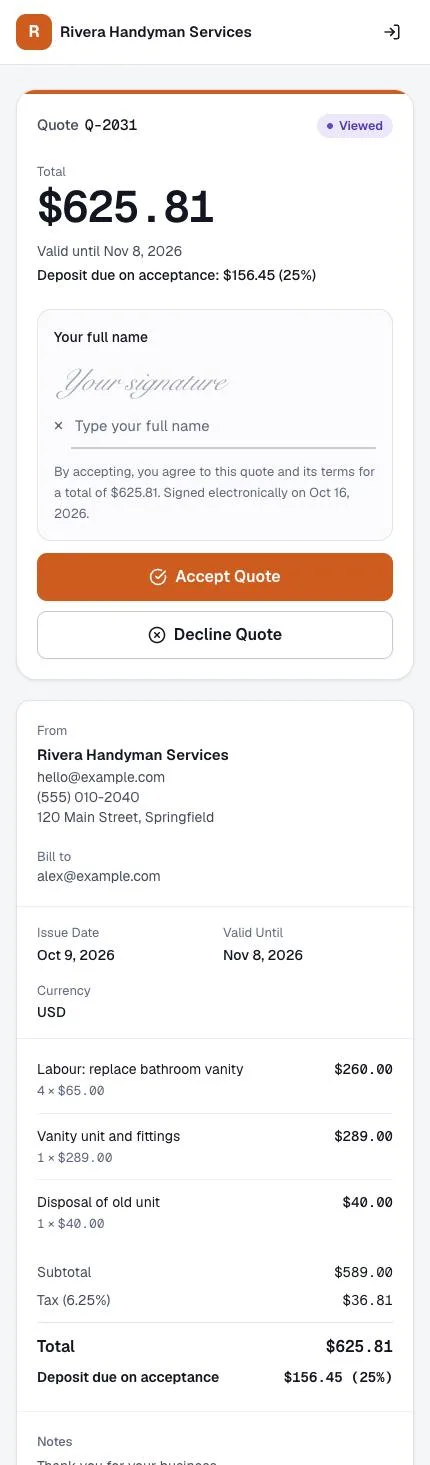
A client's view of an i-quote quote on a phone: quote Q-2031 from Rivera Handyman Services with three line items, a total of $625.81, a 25% deposit of $156.45 due on acceptance, a field for the client's full name, and Accept Quote and Decline Quote buttons.
The quote, as your client sees it on a phone: accept or decline, with the deposit shown upfront (sample data).

What the client sees once the quote becomes an invoice

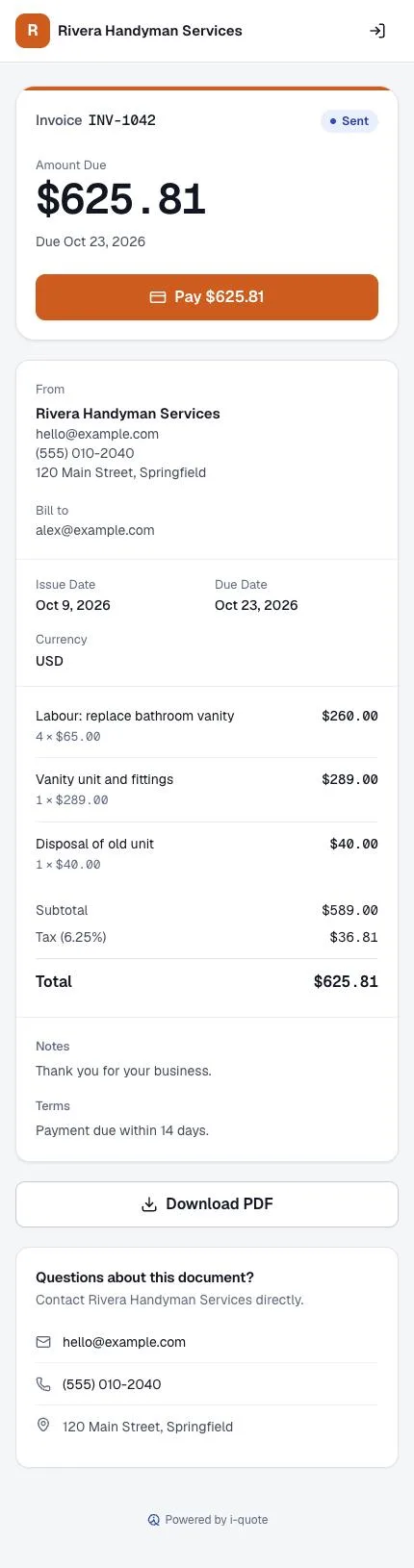
The invoice carries the same items and total as the accepted quote, plus a due date and a Pay button. Your client can pay by card from their phone in about a minute.

An i-quote invoice on a phone screen: Rivera Handyman Services, invoice INV-1042 issued Oct 9 and due Oct 23, 2026, three line items, a $625.81 total matching the accepted quote, a large Pay $625.81 button and a Download PDF link.
The invoice made from that quote: same total, now with a due date and a Pay button (sample data).

Frequently asked questions

Is a free estimate the same as a free quote?
Not always. "Free estimate" usually means a no-charge rough price; "free quote" usually means a no-charge fixed price after you have seen the job. Say on the document which one it is.
Is a quote legally binding?
It depends on where you work, what the quote says and whether the client accepted it. Rules differ by state and country, so check your local rules or ask a professional. A clear scope, a "valid until" date and written acceptance avoid most disputes.
Can a quote change after the client accepts it?
Only by agreement. If the client asks for extra work, or you find something outside the agreed scope, send a revised quote or a written change and get it approved before you do the work.
Do I need to send an invoice if the client already accepted a quote?
Yes. The quote records what you agreed; the invoice is the request for payment, with its own number, issue date and due date, and it is what you and your client keep for your records.
Should an invoice show the quote number?
It helps. Putting the quote number, or the client's purchase order number, on the invoice lets the client match it to what they approved and pay it faster.